

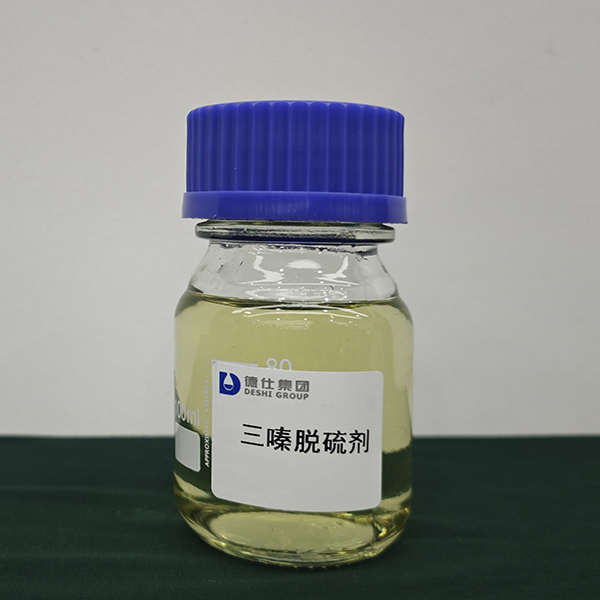
Product Introduction
The triazine desulfurizer independently produced by the company has a triazine compound content of 40% -78%, which can not only meet the technical requirements of different oil fields, but also improve the efficiency of the product under different conditions. It can quickly and effectively reduce the concentration of hydrogen sulfide and solve safety and corrosion problems caused by oil field production.
At present, triazine desulfurizer is the most economical and effective product for removing H2S in oil and gas production, and occupies an irreplaceable position among many desulfurizers. Easy to dissolve in water, antibacterial, low toxicity, reduces corrosion of low-carbon steel, and is biodegradable.
Technical Indicators
project | index | Testing standards |
appearance | uniform liquid | visualization |
Solubility | Easy to dissolve in water | visualization |
pH value | 7—9 | GB/T 9724 |
Concentration of triazine compounds | ≥40% | GB/T 6680-2003 |
Desulfurization rate | ≥90% | SY/T 6277-2005 |
Organic chlorine content | 0.0% | Q/SH1020 2093-2016 |
Application
When using this product, it can be directly injected continuously or added by impact at the wellhead casing. Gas wells can use gas pipelines to directly cut in and remove sulfur. It is recommended to install a dosing device at the wellhead for continuous injection.
A simple dosing device uses a funnel to add medication at the mouth of the casing pipe. If injected under pressure through a pump truck, this method belongs to the impact dosing method, which has a slow reaction time and uneven penetration. It is generally only widely used during operation;
Continuous injection type, added to the extracted liquid, requires the installation of a dosing device and uniform injection through a plunger pump. Its effect is better than that of impact dosing, and the reaction is fast. The dosing concentration is reasonably controlled, which is safe and convenient;
In theory, if the concentration of hydrogen sulfide in the extracted liquid is 100ppm (i.e. 1 cubic meter of extracted liquid contains 0.1kg of hydrogen sulfide), then 0.1kg to 0.6kg of desulfurizer needs to be added to 1 cubic meter of extracted liquid. The amount of desulfurizer used in natural gas systems is generally 0.5kg to 2kg per cubic meter. The specific dosage can be adjusted according to the hydrogen sulfide concentration at the on-site testing point.
The product should be stored in a cool, dry, and well ventilated place.
